
How many adults in the US do not have dental insurance? What’s the value of integrating oral health into interprofessional education? How much does it cost to treat non-traumatic dental conditions in an emergency department?
In 2025, CareQuest Institute analysts and authors answered those questions — and many more — through our research and publications.
The answers to those questions then drive systems change, giving providers, policymakers, and advocates knowledge and insights to improve the oral health system. From the importance of medical-dental integration to the inequities facing communities of color, our work illuminates the myriad challenges and opportunities in oral health care.
Which publications resonated most with our readers in 2025?
We’ve compiled the top five most-viewed publications of the year, highlighting insights into the current oral health landscape in the US and opportunities for improvement in the future.
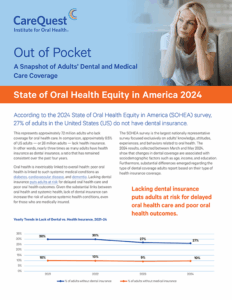
1. Out of Pocket: A Snapshot of Adults’ Dental and Medical Care Coverage
Approximately 72 million adults in the US (27%) do not have dental insurance. That’s almost three times the number of adults who lack health insurance. These findings come from CareQuest Institute’s 2024 State of Oral Health Equity in America (SOHEA) survey, which sheds light on the attitudes, experiences, and behaviors of more than 9,000 adults when it comes to oral health. In this report, researchers unpacked the key insights and explored what they reveal about the state of dental care in America today.
2. Transforming Oral Health Care Through Interprofessional Education
Interprofessional education (IPE) is all about collaboration — where students from different health care disciplines engage in shared learning. Yet, oral health education (like dental and dental hygiene programs) has traditionally been siloed, separate from other areas of health care. This separation matters because oral health is deeply connected to overall health, influencing conditions such as diabetes, heart disease, and respiratory infections.
This white paper from CareQuest Institute with contributions from 19 academic institutions highlighted why integrating oral health into IPE is critical. The authors concluded that IPE is essential for creating collaborative, patient-centered care — and for breaking down the barriers that have long divided dental care from medical care.
3. Medicaid Adult Dental Benefits Offered to Specific Beneficiary Groups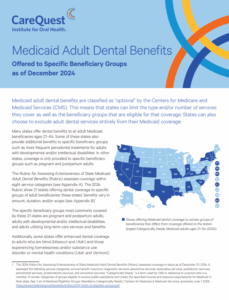
Medicaid adult dental benefits aren’t guaranteed — they are considered “optional” by the Centers for Medicare and Medicaid Services (CMS). This gives states the power to limit the types of services covered, restrict eligibility to certain beneficiary groups, and even exclude adult dental care entirely.
An updated CareQuest Institute report revealed that 21 states now provide extra dental coverage for specific populations, such as pregnant adults and adults with disabilities. The report also included a detailed rubric showing how states vary in coverage across eight categories: diagnostic, preventive, restorative, endodontic, periodontal, prosthodontic, and extraction services, as well as annual benefit maximum.
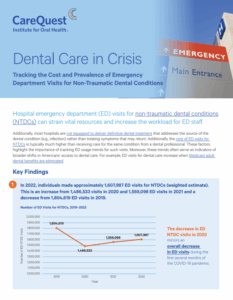
Emergency department (ED) visits for non-traumatic dental conditions (NTDCs) may have declined since 2019, but they’re costing more. In fact, costs have risen by $500 million. These visits strain hospital resources and add pressure to already overworked ED staff. On top of that, most hospitals aren’t equipped to provide definitive dental treatment, meaning patients often leave with temporary relief rather than a real solution.
In this analysis, CareQuest Institute researchers dug into the numbers and trends behind ED usage for dental issues — and what these patterns reveal about broader challenges in access to dental care across America.
5. Partners in Progress: Pursuing Medical-Dental Integration in Ohio
For two years, the Medical Oral Expanded Care (MORE Care) Ohio pilot program, led by CareQuest Institute and Oral Health Ohio, worked to integrate oral health into pediatric primary care across six counties in the state. The initiative brought together seven private and health-system-affiliated practices to expand access to preventive dental services for nearly 20,000 children.
This impact report and case study gave a behind-the-scenes look inside the MORE Care Ohio program, highlighting its design, implementation, and outcomes.