
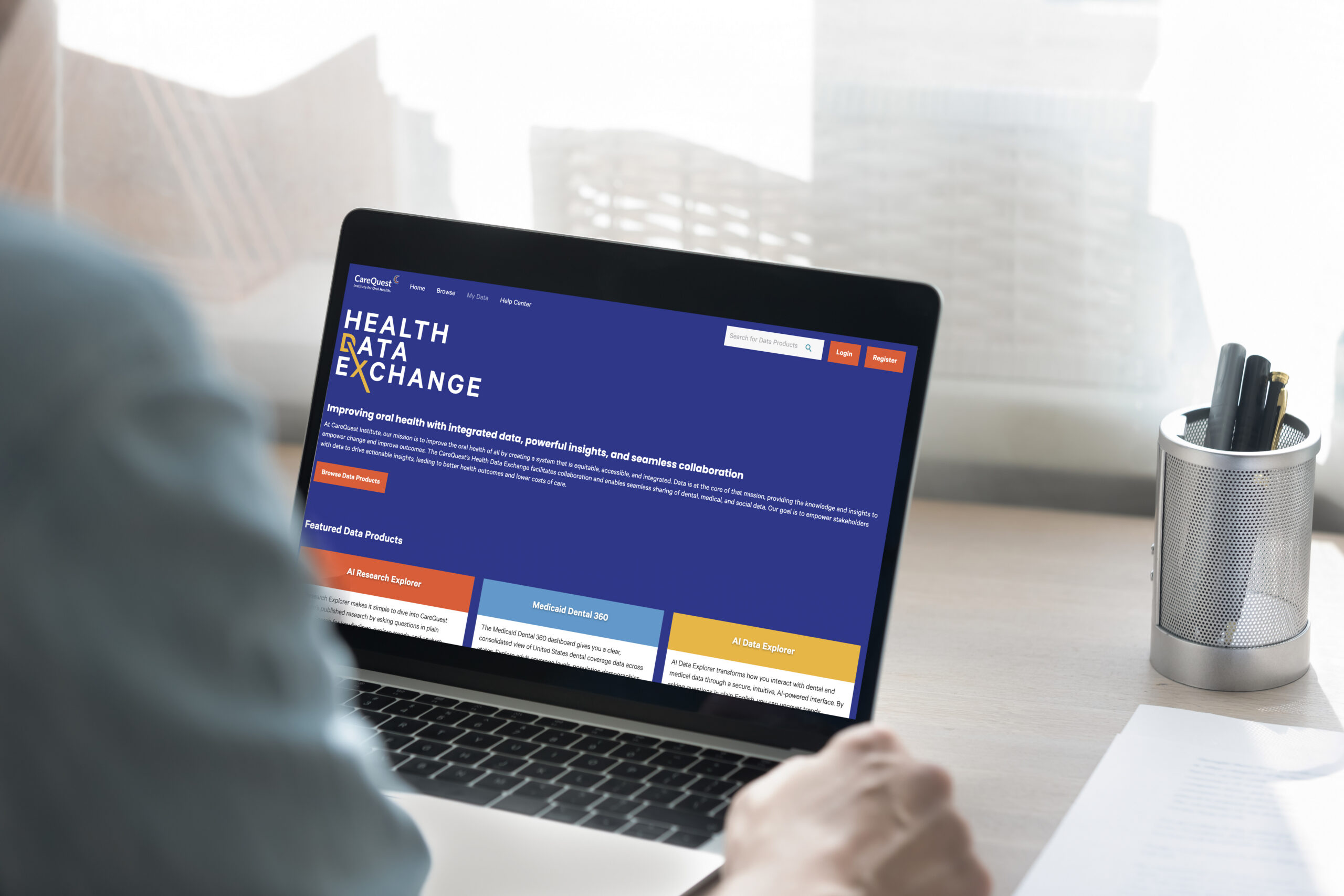
What does Medicaid adult dental coverage look like across states? Where do shortages of medical and dental providers exist? How many people in a specific county have dental insurance?
Now, you can find all those answers — and much, much more — in one place.
This spring, CareQuest Institute launched its most ambitious data offering to date, a platform that connects medical, oral health, and social data. The Health Data Exchange, which includes an AI Research Explorer, provides oral health stakeholders — from advocates to policymakers and everyone in between — with tools and knowledge to improve decision-making and strengthen care in communities across the country.
“CareQuest Institute’s Health Data Exchange empowers users to access oral health data in the way they need it most,” says Rebecca Preston, CareQuest Institute Senior Manager of Analytics & Data Insights. “The combination of the medallion architecture [a trusted way to organize data so it’s ready to use], AI, and data products delivers insights faster and accurately to support our partners in advancing our mission of improving oral health for all.”
After months of development from the Analytics & Data Insights (ADI) team, John Bowyer, Data Engineer Manager, and Adrianna Sonnek, Data Products Manager, share more about why the Health Data Exchange was created, how it will help advocates, researchers, and oral health stakeholders, and what success looks like.
Q: Why did the ADI team build the Health Data Exchange?
Bowyer: Before the Health Data Exchange, analysts spent weeks manually pulling together state‑level data from multiple disconnected sources. That approach did not scale with our goal of advancing health equity nationwide. We built the Health Data Exchange to move from fragmented data silos to a unified platform.
Q: Who is the Health Data Exchange designed for, and how do you envision people using it?
Sonnek: The Health Data Exchange is designed for anyone who is interested in oral health data — no matter their level of experience.
Data products, like our AI Research Explorer, allow people without technical expertise to easily gather insights in seconds. At the same time, our analytic workbench tools give advanced researchers the space and capabilities to conduct more complex analyses on one centralized platform.
Q: How did the ADI team build the Health Data Exchange?
Sonnek: To start this endeavor, we first had to create a data strategy that kept us centered around CareQuest Institute’s mission and values. We interviewed valuable colleagues and partners across our network and collectively recognized that there needed to be a solution to group all the data together into an easy-to-use platform to extend our reach. We then started planning and building the technical infrastructure needed to support this. Months of work went into shaping our data and platform to make the Health Data Exchange what it is today. We are excited to show off the brand-new data products developed to coincide with the launch of the Health Data Exchange. For example:
- AI Research Explorer
- AI Data Explorer
- Medicaid 360
- Workbench options for advanced analysis
Q: How is artificial intelligence (AI) integrated into the Health Data Exchange?
Sonnek: AI is integrated into the development process for data products, optimizing our processes so that we can develop as many helpful resources as possible. Beyond that, it is also available to users of the Health Data Exchange so that they can take our extensive data resources and quickly gain the insights they are looking for — without the steep learning curve that often comes with analyzing new data sources.
Q: How is the Health Data Exchange maintained?
Sonnek: The Data Products team supports users by answering questions, assisting with data requests, and providing technical help. They also gather feedback from the research community and use it to improve existing tools and develop new ones. Our Data Engineering team supports data ingestion and maintains data infrastructure, which enables our team to improve and update our tools. They also gather feedback from the research community and use it to improve existing tools and develop new ones.
Q: What part of launching the Health Data Exchange are you most excited about?
Sonnek: I am most excited about seeing how people use the tools we’ve built to solve real-world problems. It’s rewarding to see new users jump into the Health Data Exchange, find answers quickly, and apply those insights in their everyday work to advance oral health equity for all.
Q: Can you give us an example of the Health Data Exchange in action?
Sonnek: Recently, we provided a Hill Day training session for OPEN members. During Hill Day, OPEN members and advocates meet with legislators in Washington, DC, about prioritizing oral health in their communities. In preparation for the training session, we met with a member to discuss what specific questions they have about their state and how long they have to discuss these data points with their legislators (which is not very long!). We helped training attendees answer the following questions, which helped with Hill Day preparation:
- What does oral health status look like for veterans compared to nonveterans?
- What has CareQuest Institute published on veterans’ oral health?
- What does Medicaid coverage look like in my state?
- Which dental procedures are covered by Medicaid?
- Is preventive coverage included in Medicaid?
- How do Medicaid enrollment numbers compare to the state’s general population?
- Which areas are considered Dental Health Professional Shortage areas?
Q: What does success look like in the first few years after the launch?
Bowyer: In the first year, success is building adoption and trust. Teams can find and analyze data on their own without relying on the Data Engineering team as an intermediary. The time from question to answer decreases because the data is already integrated and governed, and users rely less on manual extracts and one-off requests.
Sonnek: We want the Health Data Exchange to become a trusted source for oral health data and insights — one that people turn to and cite regularly. As we expand our data resources and tools, we aim to show that oral health is health and make it easier include oral health topics in the overall health conversation.
Learn more about the Health Data Exchange and its data products.